Getting Started With Playwright Testing
Playwright is a Node.js library that uses a single API to automate Chromium, Firefox, and WebKit. It is designed to enable powerful, reliable, and efficient automated browser testing. Playwright can also automate Microsoft Edge since it is built on the open-source Chromium web framework.
If you do End-to-End (E2E) testing with Playwright, you can run those same tests on TestMu AI instead of your local machine. This gives your Playwright suite access to real browsers and operating system combinations, so you catch issues that only appear on specific platforms. You point Playwright at the TestMu AI grid through a CDP WebSocket endpoint, pass your credentials and a capabilities object, then view the results on the Automation Dashboard.
You can run tests using Playwright versions v1.15.0 to the latest.
Prerequisites
Note: All the code samples in this documentation can be found in the TestMu AI's Repository on GitHub. You can either download or clone the repository to quickly run your tests.
View on GitHub
-
Clone the TestMu AI-Playwright repository on your system.
-
Install the npm dependencies.
npm install
- Add browserWSEndpoint (browser end point URL) in your test script.
wsEndpoint: `wss://cdp.lambdatest.com/playwright?capabilities=${encodeURIComponent(JSON.stringify(capabilities))}`
- In order to run your Playwright tests, you will need to set your TestMu AI username and access key in the environment variables. Click the Access Key button at the top-right of the Automation Dashboard to access it.
Windows
set LT_USERNAME="YOUR_LAMBDATEST_USERNAME"
set LT_ACCESS_KEY="YOUR_LAMBDATEST_ACCESS_KEY"
macOS/Linux
export LT_USERNAME="YOUR_LAMBDATEST_USERNAME"
export LT_ACCESS_KEY="YOUR_LAMBDATEST_ACCESS_KEY"
Run Your First Test
This section builds a single Playwright script that connects to the TestMu AI grid and runs one test. Start with the connection snippet, then use the full script that searches Bing and reports its status.
Prefer not to edit your test scripts? Run your existing Playwright suite on the grid with no code changes using the SDK. See Run Tests With the SDK.
- Add the code snippet below to your test script.
(async () => {
  const capabilities = {
    'browserName': 'Chrome', // Browsers allowed: `Chrome`, `MicrosoftEdge`, `pw-chromium`, `pw-firefox` and `pw-webkit`
    'browserVersion': 'latest',
    'LT:Options': {
      'platform': 'Windows 10',
      'build': 'Playwright Sample Build',
      'name': 'Playwright Sample Test',
      'user': process.env.LT_USERNAME,
      'accessKey': process.env.LT_ACCESS_KEY,
      'network': true,
      'video': true,
      'console': true
    }
  }

  const browser = await chromium.connect({
    wsEndpoint: `wss://cdp.lambdatest.com/playwright?capabilities=${encodeURIComponent(JSON.stringify(capabilities))}`
  })
Once you are done with the above-mentioned steps, you can initiate your first Playwright test on TestMu AI.
The below test script searches the term 'TestMu AI' on DuckDuckGo.
const { chromium } = require('playwright')
const { expect } = require('@playwright/test');

(async () => {
  const capabilities = {
    'browserName': 'Chrome', // Browsers allowed: `Chrome`, `MicrosoftEdge`, `pw-chromium`, `pw-firefox` and `pw-webkit`
    'browserVersion': 'latest',
    'LT:Options': {
      'platform': 'Windows 10',
      'build': 'Playwright Sample Build',
      'name': 'Playwright Sample Test',
      'user': process.env.LT_USERNAME,
      'accessKey': process.env.LT_ACCESS_KEY,
      'network': true,
      'video': true,
      'console': true
    }
  }

  const browser = await chromium.connect({
    wsEndpoint: `wss://cdp.lambdatest.com/playwright?capabilities=${encodeURIComponent(JSON.stringify(capabilities))}`
  })

  const page = await browser.newPage()

  await page.goto('https://duckduckgo.com')

  const element = await page.$('[name="q"]')
  await element.click()
  await element.type('TestMu AI')
  await element.press('Enter')
  const title = await page.title()

  try {
    expect(title).toEqual('TestMu AI at DuckDuckGo')
    // Mark the test as completed or failed
    await page.evaluate(_ => {}, `lambdatest_action: ${JSON.stringify({ action: 'setTestStatus', arguments: { status: 'passed', remark: 'Title matched' } })}`)
  } catch {
    await page.evaluate(_ => {}, `lambdatest_action: ${JSON.stringify({ action: 'setTestStatus', arguments: { status: 'failed', remark: 'Title not matched' } })}`)
  }

  await browser.close()
})()
- Pass the below command to run the test.
node playwright-single.js
Run Tests in Parallel
Once your first test runs, you can execute the same test across multiple browser and OS configurations at once. Define a capabilities array (one entry per configuration) and run each through a shared function.
The example below runs the DuckDuckGo search test on three configurations: Chrome on Windows 10, Microsoft Edge on Windows 11, and Chrome on macOS Sonoma.
const { chromium } = require('playwright')
const { expect } = require('@playwright/test')

const parallelTests = async (capability) => {
  console.log('Initialising test:: ', capability['LT:Options']['name'])

  const browser = await chromium.connect({
    wsEndpoint: `wss://cdp.lambdatest.com/playwright?capabilities=${encodeURIComponent(JSON.stringify(capability))}`
  })

  const page = await browser.newPage()

  await page.goto('https://duckduckgo.com')

  const element = await page.$('[name="q"]')
  await element.click()
  await element.type('TestMu AI')
  await element.press('Enter')
  const title = await page.title()

  try {
    expect(title).toEqual('TestMu AI at DuckDuckGo')
    // Mark the test as completed or failed
    await page.evaluate(_ => {}, `lambdatest_action: ${JSON.stringify({ action: 'setTestStatus', arguments: { status: 'passed', remark: 'Title matched' } })}`)
  } catch {
    await page.evaluate(_ => {}, `lambdatest_action: ${JSON.stringify({ action: 'setTestStatus', arguments: { status: 'failed', remark: 'Title not matched' } })}`)
  }

  await browser.close()
}

// Capabilities array with the respective configuration for the parallel tests
const capabilities = [
  {
    'browserName': 'Chrome', // Browsers allowed: `Chrome`, `MicrosoftEdge`, `pw-chromium`, `pw-firefox` and `pw-webkit`
    'browserVersion': 'latest',
    'LT:Options': {
      'platform': 'Windows 10',
      'build': 'Playwright Sample Build',
      'name': 'Playwright Sample Test on Windows 10 - Chrome',
      'user': process.env.LT_USERNAME,
      'accessKey': process.env.LT_ACCESS_KEY,
      'network': true,
      'video': true,
      'console': true
    }
  },
  {
    'browserName': 'MicrosoftEdge',
    'browserVersion': 'latest',
    'LT:Options': {
      'platform': 'Windows 11',
      'build': 'Playwright Sample Build',
      'name': 'Playwright Sample Test on Windows 11 - MicrosoftEdge',
      'user': process.env.LT_USERNAME,
      'accessKey': process.env.LT_ACCESS_KEY,
      'network': true,
      'video': true,
      'console': true
    }
  },
  {
    'browserName': 'Chrome',
    'browserVersion': 'latest',
    'LT:Options': {
      'platform': 'MacOS Sonoma',
      'build': 'Playwright Sample Build',
      'name': 'Playwright Sample Test on MacOS Sonoma - Chrome',
      'user': process.env.LT_USERNAME,
      'accessKey': process.env.LT_ACCESS_KEY,
      'network': true,
      'video': true,
      'console': true
    }
  }]

capabilities.forEach(async (capability) => {
  await parallelTests(capability)
})
Run the parallel test:
node playwright-parallel.js
View your Playwright test results
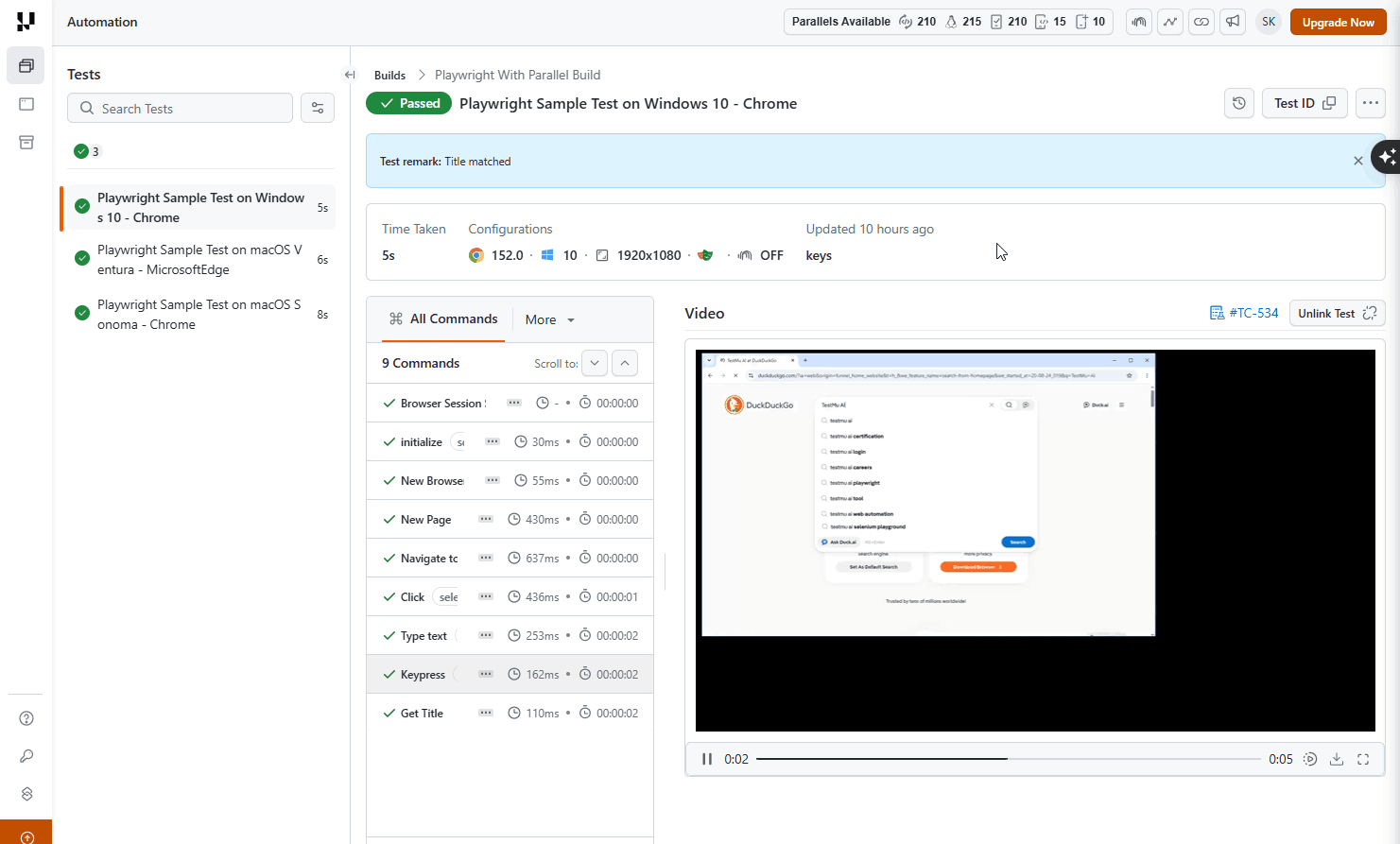
The TestMu AI Automation Dashboard is where you can see the results of your Playwright tests after running them on the TestMu AI platform.
You can view the details of Playwright test session that you just executed.
For example, the below screenshot shows a test execution details of Playwright test like Test Name, Test ID, selected configurations, test logs, basic info, input config, and test session video.
npm install @lambdatest/playwright-node-sdk
2. Generate the config file, then set your credentials, platforms, and run settings in it:
Verifiednpx playwright-node-sdk --init
Example lambdatest.yml
# Access your LambdaTest credentials from https://accounts.lambdatest.com/security/username-accesskey
# It's recommended to use environment variables for your credentials.
user: {YOUR_LAMBDATEST_USERNAME}
accessKey: {YOUR_LAMBDATEST_ACCESS_KEY}

# Build name for your test run
build: "Playwright Node.js SDK Build"

# Name of the test suite
name: "Playwright Test Suite"

# Global base configuration
framework: "playwright" # Framework name
source: "node-js-playwright-sample-sdk:latest" # GitHub branch and tag

# Optional: Build and project tags for organization and filtering
buildTags: ["playwright", "nodejs", "typescript"]
tags: ["smoke", "regression"]
projectName: "Playwright Node SDK Testing"

# Define the number of parallel sessions for each configuration
parallelsPerPlatform: 2

# Optional: Advanced settings applied to all tests
network: false # To capture network HAR logs (may impact test execution speed)
console: false # To capture browser console logs (may impact test execution speed)
video: true # To capture video for debugging (may impact test execution speed)
tunnel: false # To test pages behind a VPN/private network or from a local system
dedicatedProxy: false
idleTimeout: 300
timezone: "UTC"
visual: true # To capture a screenshot for each command (may impact test execution speed)
headless: false # To run tests in headless mode. Note: Video will not be available for headless tests.
commandLog: true # To capture commands that are executed on the platform
resolution: "1280x960" # To set the global resolution/viewport size to execute tests

# Tunnel-specific tests
tunnel_settings:
  # tunnel: true
  # autostart: true
  # tunnelName: "app-behind-firewall-localhost-test-tunnel"

# Global Playwright configuration (inherited by all platforms unless overridden)
playwrightConfigOptions:
  testDir: "tests"

# Refer to the capability generator for detailed configurations: https://www.testmuai.com/capabilities-generator/
platforms:
  - platform: "macOS Sequoia" # Or "Windows 11", "android", "ios"
    browserName: "chrome" # Or pw-firefox, pw-webkit
    browserVersion: "latest"
3. Run your tests through the SDK wrapper (you can pass any standard Playwright CLI option):
Verifiednpx playwright-node-sdk playwright test
When you run this, the SDK reads lambdatest.yml, starts the TestMu AI Tunnel if enabled, generates a temporary Playwright config that connects to the grid, runs your tests, and reports results (video, screenshots, network, and console logs) to your Dashboard.
Override Your Playwright Config
The playwrightConfigOptions block in lambdatest.yml overrides your project's native Playwright configuration for the cloud run, so you can adjust test selection and global options without editing playwright.config.js.
- testDir sets the folder Playwright looks in for test files:
playwrightConfigOptions:
  testDir: './tests'
- testMatch and testIgnore are glob patterns that include or exclude specific test files:
playwrightConfigOptions:
  testMatch: /.*\.e2e\.js/
  testIgnore: /.*\.spec\.js/
- setup and teardown are scripts that run before and after your suite:
playwrightConfigOptions:
  setup:
    - name: 'setup1'
      testMatch: '**/*.setup.ts'
      teardown: 'teardown1'
  teardown:
    - name: 'teardown1'
      testMatch: '/teardown\.ts/'
- use sets global options applied to every test in the run, such as a shared
baseURL:
playwrightConfigOptions:
  use:
    baseURL: 'https://www.example.com'
Run a Specific Test File
Because the SDK wraps the standard playwright test command, you can pass any Playwright CLI option through it. For example, to run a single test file:
npx playwright-node-sdk playwright test tests/my-test.spec.js
Run Playwright BDD Tests
playwright-bdd lets you run Gherkin .feature files on Playwright's test runner. On TestMu AI, the @lambdatest/playwright-node-sdk runs the generated specs across the browser and OS matrix defined in your lambdatest.yml.
How Playwright BDD Works
Playwright BDD converts your Gherkin into runnable Playwright specs, then the SDK runs them on the cloud:
- Write
.featurefiles and map each step to a Playwright action in thesteps/folder. npx bddgengenerates Playwright spec files into the.features-genfolder.- The Playwright Node SDK runs those specs on TestMu AI using the configuration in
lambdatest.yml.
Running Your BDD Tests
Clone the sample repository, then install the dependencies, which include playwright-bdd and @lambdatest/playwright-node-sdk:
npm install
Verified with
playwright-bdd@8.3.1,@playwright/test@1.53.0, and@lambdatest/playwright-node-sdk@1.0.2(October 2026).
Set your TestMu AI Username and Access Key as environment variables (see Prerequisites), then generate the specs and run them on the cloud grid in a single command:
npx bddgen && npx playwright-node-sdk playwright test
Define your target browsers and operating systems in lambdatest.yml. For the full configuration, refer to the Playwright BDD sample repository.
Testing Locally Hosted Pages With Playwright BDD
To run your Playwright BDD tests against locally hosted or firewalled pages, enable the tunnel under a tunnelSettings block in your lambdatest.yml:
tunnelSettings:
  tunnel: true
  # autostart: true
  tunnelName: "tunnel-name"
  # localdirectory: "./log"
  verbose: true
  loglevel: "debug"
Set tunnel: true to route traffic through the tunnel, and tunnelName to reuse an already-running tunnel by name. The verbose and loglevel keys control the tunnel's logging output. See how to test locally hosted pages.
Viewing the BDD Results
Each scenario appears on the TestMu AI Automation Dashboard with its name, status, logs, and session video.
View Your Playwright Test Results
The TestMu AI Automation Dashboard is where you review the results of your Playwright tests after running them on the grid. Use it to confirm a run passed and to open individual sessions for debugging.
You can view the details of the Playwright test session you just executed. For example, the screenshot below shows the test execution details of a Playwright test, including test name, test ID, selected configurations, test logs, basic info, input config, and the test session video.
Related Playwright Guides
Run Playwright BDD Tests
playwright-bdd lets you run Gherkin .feature files on Playwright's test runner. On TestMu AI, the @lambdatest/playwright-node-sdk runs the generated specs across the browser and OS matrix defined in your lambdatest.yml.
How Playwright BDD Works
Playwright BDD converts your Gherkin into runnable Playwright specs, then the SDK runs them on the cloud:
- Write
.featurefiles and map each step to a Playwright action in thesteps/folder. npx bddgengenerates Playwright spec files into the.features-genfolder.- The Playwright Node SDK runs those specs on TestMu AI using the configuration in
lambdatest.yml.
Running Your BDD Tests
Clone the sample repository, then install the dependencies, which include playwright-bdd and @lambdatest/playwright-node-sdk:
npm install
Verified with
playwright-bdd@8.3.1,@playwright/test@1.53.0, and@lambdatest/playwright-node-sdk@1.0.2(October 2026).
Set your TestMu AI Username and Access Key as environment variables (see Prerequisites), then generate the specs and run them on the cloud grid in a single command:
npx bddgen && npx playwright-node-sdk playwright test
Define your target browsers and operating systems in lambdatest.yml. For the full configuration, refer to the Playwright BDD sample repository.
Testing Locally Hosted Pages With Playwright BDD
To run your Playwright BDD tests against locally hosted or firewalled pages, enable the tunnel under a tunnelSettings block in your lambdatest.yml:
tunnelSettings:
  tunnel: true
  # autostart: true
  tunnelName: "tunnel-name"
  # localdirectory: "./log"
  verbose: true
  loglevel: "debug"
Set tunnel: true to route traffic through the tunnel, and tunnelName to reuse an already-running tunnel by name. The verbose and loglevel keys control the tunnel's logging output. See how to test locally hosted pages.
Viewing the BDD Results
Each scenario appears on the TestMu AI Automation Dashboard with its name, status, logs, and session video.
Related Playwright guides
-
Playwright WebView Testing - automate WebView components using Playwright on TestMu AI.
-
Migrate Existing Playwright Tests - move your existing Playwright suite to the TestMu AI cloud.
-
Migrate your existing Playwright suite to the cloud moves tests you already run locally onto the TestMu AI grid.
-
Set up Playwright test execution on TestMu AI configures your project to run Playwright tests on the cloud.
-
Configure Playwright capabilities customizes browser, OS, and session options for your runs.
-
Automate WebView components with Playwright tests WebView apps on the TestMu AI grid.
 Chat with Us