How to Debug your CLI Errors
This document will help you debug your failed job if you are facing any CLI issues.
If the CLI printed an error code such as ERR::HTTP::RESP, look it up in Error Codes below.
If you are encountering any error which is properly not detailed, it is recommend to use verbose mode in HyperExecute CLI command.
Symbolic Link Error
This error will mark your Job as a Lambda Error.
You can encounter this error when you try to upload the node_modules directory along with the payload to trigger your Job in HyperExecute. This error generally occurs with your Node.js projects. You must avoid doing this, as it will not only save storage space but also avoid potential issues with version control. The node_modules folder holds all the project dependencies, and adding it to the repository can cause unnecessary file duplication and increase the repository size.
To resolve this issue, either you remove that directory or you simply add node_modules to the .gitignore file. This ensures you have a smooth development process without unnecessary hiccups.
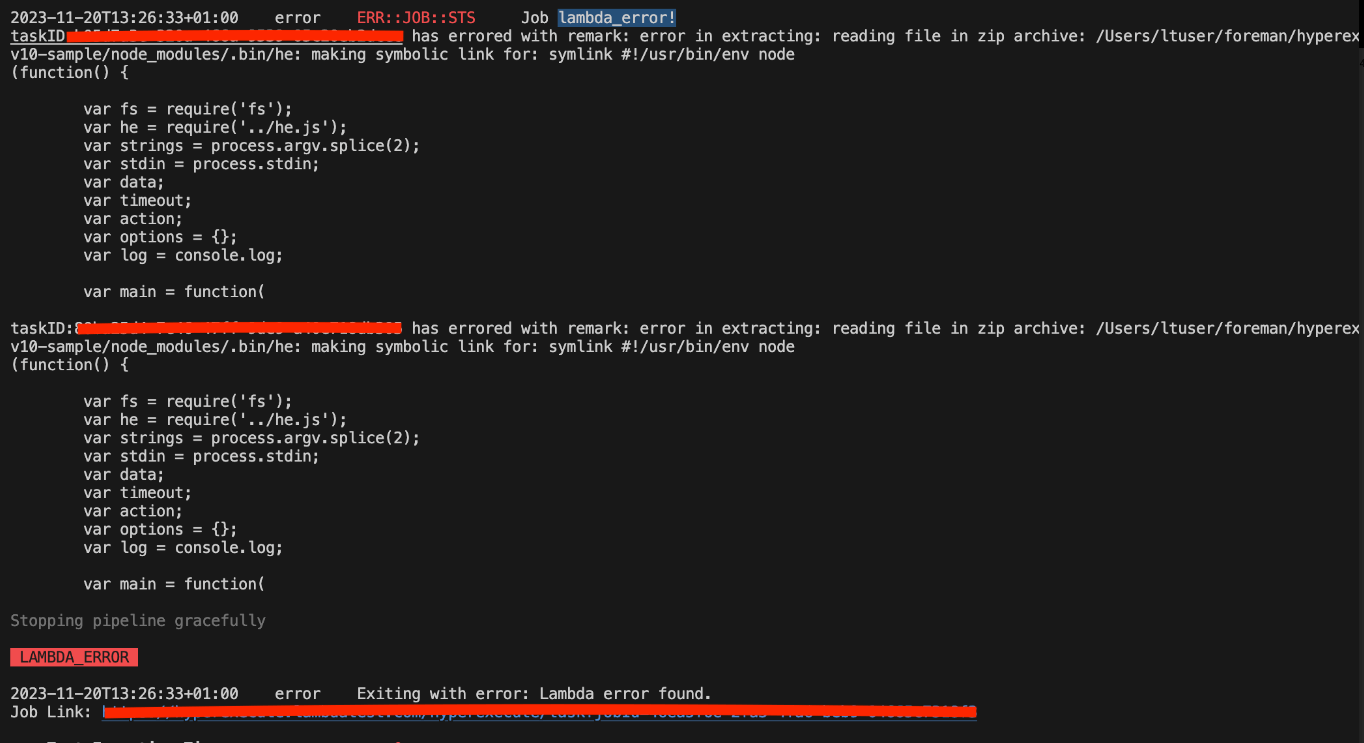
The CLI output looks like this:
error    ERR::JOB::STS     Job lambda_error!
taskID:<task-id> has errored with remark: error in extracting: reading file in zip archive: <path>/node_modules/.bin/he: making symbolic link for: symlink #!/usr/bin/env node
LAMBDA_ERROR
error    Exiting with error: Lambda error found.
Snooper Failed Error
It's crucial to understand a specific characteristic of Gherkin – it exclusively supports the use of Examples with the Scenario Outline. If you come across an error, it likely indicates that the Scenario is being employed with Examples instead of the intended Scenario Outline. To resolve this, ensure that you use the appropriate structure, employing the Scenario Outline when incorporating Examples.
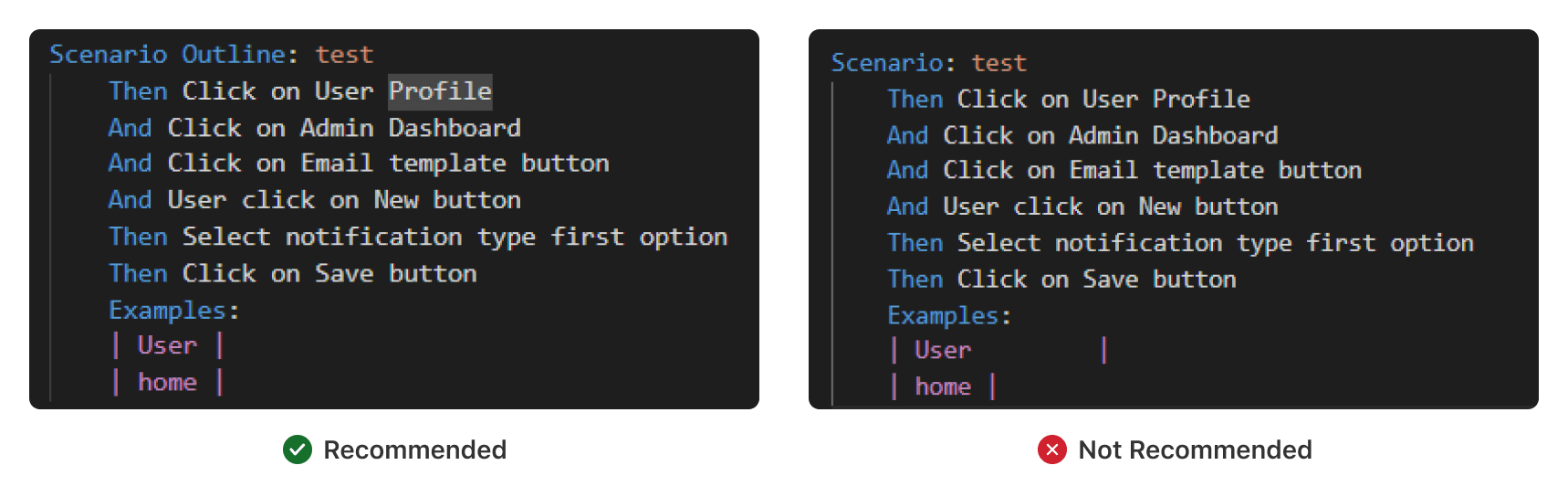
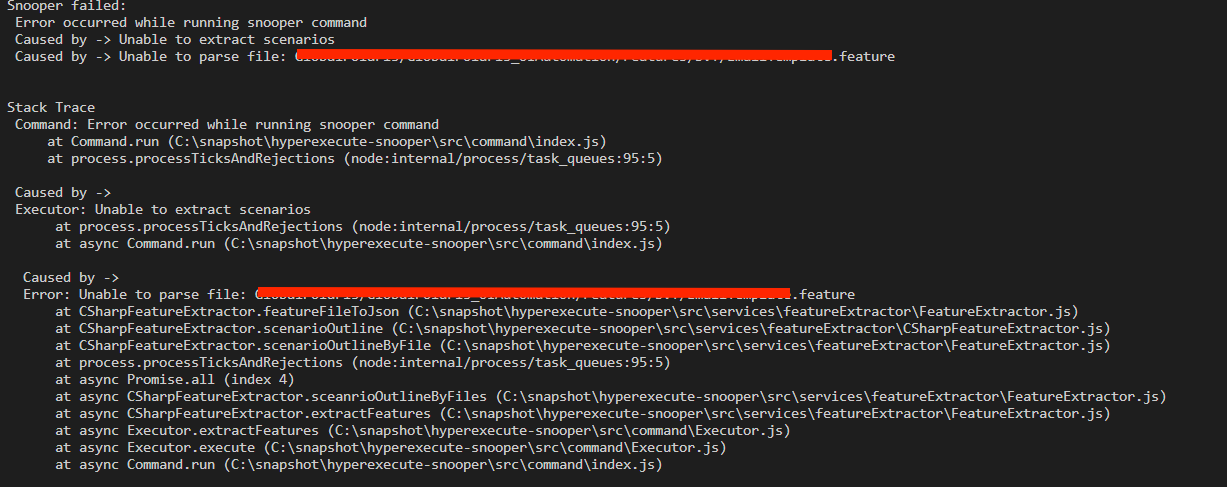
The CLI prints output like this:
Snooper failed:
 Error occurred while running snooper command
 Caused by -> Unable to extract scenarios
 Caused by -> Unable to parse file: <path>/<file>.feature
Use Examples only under a Scenario Outline:
Scenario Outline: test
  Then Click on User Profile
  And Click on Admin Dashboard
  Then Click on Save button
  Examples:
    | User |
    | home |
Not under a plain Scenario, which causes the error above:
Scenario: test
  Then Click on User Profile
  And Click on Admin Dashboard
  Then Click on Save button
  Examples:
    | User |
    | home |
Authentication Error
There may be cases where, when trying to connect to HyperExecute services, the CLI throws the following error:

error ERR:HTTP:HOST Facing problem in connecting with LUMS_HOST :: https://auth.hyperexecute.cloud - prod - error in authenticating user.
If the CLI printed an error code such as ERR::NO::USER, ERR::NO::KEY, or ERR::HTTP::RESP, see Error Codes below.
Now, to validate the connectivity and to make sure the auth.hyperexecute.cloud is reachable, you have to run a scan command in your CLI, as shown below. If the network scan fails, then you are required to whitelist the IP address.
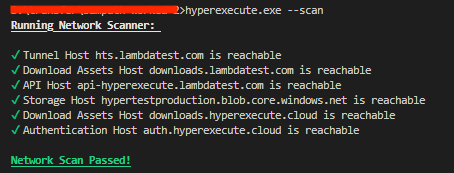
hyperexecute.exe --scan
Running Network Scanner:
✓ Tunnel Host hts.lambdatest.com is reachable
✓ Download Assets Host downloads.lambdatest.com is reachable
✓ API Host api-hyperexecute.lambdatest.com is reachable
✓ Storage Host hypertestproduction.blob.core.windows.net is reachable
✓ Download Assets Host downloads.hyperexecute.cloud is reachable
✓ Authentication Host auth.hyperexecute.cloud is reachable

Network Scan Passed!
IPs to be Whitelisted
| FQDN | Protocol:Port | Reason |
|---|---|---|
| *.hyperexecute.cloud | Https:443 | HyperExecute’s registered wildcard domain to allow access to all HyperExecute’s services |
| *.lambdatest.com | Https:443 | TestMu AI’s registered wildcard domain to allow access to all TestMu AI’s services (like auth, plan-validation) |
Error Codes
When a HyperExecute run fails, the CLI prints an error code, a short title, and a suggested fix, then exits with code 1. For example:
error    ERR::NO::USER     Unable to find LT username.    Unable to parse LT username. Use --user cli flag or LT_USERNAME environment variable
Error: ERR::NO::USER     Unable to find LT username.
The error lines are written to standard output, and the Error: line to standard error. Most codes have the form ERR::DOMAIN::REASON. Search this page for the code you see. Each code can also be written with underscores, such as ERR_NO_USER.
Documented for HyperExecute CLI v0.2.354.
The CLI checks your credentials before it validates your YAML. If your credentials are wrong, you see ERR::HTTP::RESP with a 401 even when your YAML also has a problem. Fix your credentials first, then run the command again to see any other error.
ERR::NO::USER
| Field | Value |
|---|---|
| Alias | ERR_NO_USER |
| What happened | The CLI could not find a TestMu AI username. |
| What to do | Set the LT_USERNAME environment variable, or pass --user. See how to find your username and access key. |
| Exit code | 1 |
error    ERR::NO::USER     Unable to find LT username.    Unable to parse LT username. Use --user cli flag or LT_USERNAME environment variable
Error: ERR::NO::USER     Unable to find LT username.
ERR::NO::KEY
| Field | Value |
|---|---|
| Alias | ERR_NO_KEY |
| What happened | The CLI could not find a TestMu AI access key. |
| What to do | Set the LT_ACCESS_KEY environment variable, or pass --key. See how to find your username and access key. |
| Exit code | 1 |
error    ERR::NO::KEY     Unable to find LT access key.    Unable to parse LT access key. Use --key cli flag or LT_ACCESS_KEY environment variable
Error: ERR::NO::KEY     Unable to find LT access key.
ERR::HTTP::RESP
| Field | Value |
|---|---|
| Alias | ERR_HTTP_RESP |
| What happened | The HyperExecute API returned an error status. With a wrong username or access key, the CLI prints non-20x status code 401 and Invalid user/key credentials. |
| What to do | Check your username and access key. See how to find your username and access key. |
| You may be seeing this for a different reason | Credentials are checked before your YAML. A missing framework: key, an invalid partialReports type, and a --config path that does not exist all show this code when the credentials are also wrong. Fix the credentials first. |
| Exit code | 1 |
error    ERR::UP::VER     Unable to fetch latest version from upstream  ERR::HTTP::RESP     non-20x status code 401    Invalid user/key credentials
Error: ERR::HTTP::RESP     non-20x status code 401    Invalid user/key credentials
ERR::UP::VER
| Field | Value |
|---|---|
| Alias | ERR_UP_VER |
| What happened | The CLI could not fetch its latest version from the server. |
| When you see it | With rejected credentials, it is printed on the same line as ERR::HTTP::RESP. |
| What to do | Fix the credentials problem reported by ERR::HTTP::RESP. |
| Exit code | 1 |
error ERR::UP::VER Unable to fetch latest version from upstream ERR::HTTP::RESP non-20x status code 401 Invalid user/key credentials
ERR:HTTP:HOST
| Field | Value |
|---|---|
| Alias | ERR_HTTP_HOST |
| What happened | The CLI could not connect to the HyperExecute authentication service at auth.hyperexecute.cloud. |
| What to do | Run the CLI with --scan to check each host, and allow the hosts in IPs to be Whitelisted. See Authentication Error. |
error ERR:HTTP:HOST Facing problem in connecting with LUMS_HOST :: https://auth.hyperexecute.cloud - prod - error in authenticating user.
ERR::JOB::STS
| Field | Value |
|---|---|
| Alias | ERR_JOB_STS |
| What happened | The job finished with an error status, which the CLI prints after the code, for example Job lambda_error!. |
| Example | In the Symbolic Link Error above, the status was lambda_error, caused by symbolic links in an uploaded node_modules folder. |
| What to do | Read the task remarks printed below the code. |
error ERR::JOB::STS Job lambda_error!
Quick Lookup Table
| Code | Alias | What to do |
|---|---|---|
ERR::NO::USER | ERR_NO_USER | Set LT_USERNAME or pass --user |
ERR::NO::KEY | ERR_NO_KEY | Set LT_ACCESS_KEY or pass --key |
ERR::HTTP::RESP | ERR_HTTP_RESP | Check your username and access key |
ERR::UP::VER | ERR_UP_VER | Fix the credentials problem reported with it |
ERR:HTTP:HOST | ERR_HTTP_HOST | Run --scan and allow the listed hosts |
ERR::JOB::STS | ERR_JOB_STS | Read the status and task remarks after the code |
Handling Error Codes in CI
Every failure exits with a non-zero code and prints the error code, so you can branch on it:
OUTPUT=$(hyperexecute --config hyperexecute.yaml 2>&1)
STATUS=$?
CODE=$(echo "$OUTPUT" | grep -oE 'ERR::?[A-Z0-9_]+(::?[A-Z0-9_]+)*' | head -1)

if [ "$STATUS" -ne 0 ]; then
  case "$CODE" in
    ERR::NO::USER|ERR::NO::KEY|ERR::HTTP::RESP)
      echo "Credentials problem - check LT_USERNAME and LT_ACCESS_KEY" ;;
    *)
      echo "HyperExecute CLI failed with $CODE" ;;
  esac
  exit 1
fi
YAML Validation Messages
The CLI includes these validation messages for hyperexecute.yaml. Each one names the key to fix. See the YAML reference.
| Message | What to do |
|---|---|
framework name is required under framework directive | Add name under framework. |
PlatformName is required in case of raw framework | Add platformName when you use the raw framework. |
Devices cannot be empty in case of XCUI framework | List at least one device. |
type key is required under testDiscovery directive | Add type under testDiscovery. |
Command key is required under testDiscovery directive | Add command under testDiscovery. |
Test discoverer command is required in auto split mode | Provide a discovery command when you use auto split. |
Discovery object not found in yaml | Add a testDiscovery block. |
Concurrency is required in autosplit mode | Set concurrency. |
Matrix.os is required in case of hybrid mode!! | Add matrix.os. |
multiple OS is not allowed without `matrix.os` | Declare multiple operating systems with matrix.os. |
Invalid type given in partialReports key in yaml | Correct the type value under partialReports. |
AppPath or AppId is required in case of real devices | Provide appPath or appId. |
Other Error Codes
The CLI can also print the codes below. Their causes are not documented yet. If you see one, contact support with the full CLI output.
| Code | Alias |
|---|---|
ERR::API::MAX::RET | ERR_API_MAX_RET |
ERR::API::RES::4XX | ERR_API_RES_4XX |
ERR::API::SRV::STR | ERR_API_SRV_STR |
ERR::ART::POL | ERR_ART_POL |
ERR::AZCOPY::DOWN | ERR_AZCOPY_DOWN |
ERR::BASE::HTY | ERR_BASE_HTY |
ERR::BIN::DOWN | ERR_BIN_DOWN |
ERR::BIN::INV | ERR_BIN_INV |
ERR::BIN::UPD | ERR_BIN_UPD |
ERR::DAR::PAR | ERR_DAR_PAR |
ERR::DAR::READ | ERR_DAR_READ |
ERR::DAS::CHM | ERR_DAS_CHM |
ERR::DAS::ODR | ERR_DAS_ODR |
ERR::DAS::RDR | ERR_DAS_RDR |
ERR::DATA::INV | ERR_DATA_INV |
ERR::DATA::LMT | ERR_DATA_LMT |
ERR::DATA::NTFND | ERR_DATA_NTFND |
ERR::DIR::NTFND | ERR_DIR_NTFND |
ERR::DIS::INFLIGHT | ERR_DIS_INFLIGHT |
ERR::DIS::RESP | ERR_DIS_RESP |
ERR::DWN::ART | ERR_DWN_ART |
ERR::DWN::RPT | ERR_DWN_RPT |
ERR::EXE::DOWN | ERR_EXE_DOWN |
ERR::FIL::STA | ERR_FIL_STA |
ERR::FILE::CHK | ERR_FILE_CHK |
ERR::FILE::WALK | ERR_FILE_WALK |
ERR::GIT::UPL | ERR_GIT_UPL |
ERR::HTTP::GET | ERR_HTTP_GET |
ERR::HTTP::NTFND | ERR_HTTP_NTFND |
ERR::HTTP::SRV | ERR_HTTP_SRV |
ERR::INF::API::MAX::ATTEMPT | ERR_INF_API_MAX_ATTEMPT |
ERR::INH::HT_YAML | ERR_INH_HT_YAML |
ERR::INV::ARCH | ERR_INV_ARCH |
ERR::INV::CYP | ERR_INV_CYP |
ERR::INV::ENV | ERR_INV_ENV |
ERR::INV::MVN | ERR_INV_MVN |
ERR::INV::NUG | ERR_INV_NUG |
ERR::IO::CPY | ERR_IO_CPY |
ERR::IO::READ | ERR_IO_READ |
ERR::IO::WRITE | ERR_IO_WRITE |
ERR::JAR::DOWN | ERR_JAR_DOWN |
ERR::JOB::ABT | ERR_JOB_ABT |
ERR::JOB::DIS | ERR_JOB_DIS |
ERR::JOB::DTL | ERR_JOB_DTL |
ERR::JOB::FLR | ERR_JOB_FLR |
ERR::JOB::INI | ERR_JOB_INI |
ERR::JOB::POL | ERR_JOB_POL |
ERR::JOB::UPL | ERR_JOB_UPL |
ERR::JSON::DCD | ERR_JSON_DCD |
ERR::JSON::MAR | ERR_JSON_MAR |
ERR::JSON::UN_MAR | ERR_JSON_UN_MAR |
ERR::NET::LSTN | ERR_NET_LSTN |
ERR::NET::PORT | ERR_NET_PORT |
ERR::NO::HTY | ERR_NO_HTY |
ERR::OS::CHMOD | ERR_OS_CHMOD |
ERR::OS::CRT_DIR | ERR_OS_CRT_DIR |
ERR::OS::CRT_FIL | ERR_OS_CRT_FIL |
ERR::OS::ENV | ERR_OS_ENV |
ERR::OS::FILE | ERR_OS_FILE |
ERR::OS::GET_DIR | ERR_OS_GET_DIR |
ERR::OS::HOME | ERR_OS_HOME |
ERR::OS::OPEN | ERR_OS_OPEN |
ERR::OS::READ | ERR_OS_READ |
ERR::OS::RMV | ERR_OS_RMV |
ERR::OS::RMVALL | ERR_OS_RMVALL |
ERR::OS::WRITE | ERR_OS_WRITE |
ERR::PAR::HT_YAML | ERR_PAR_HT_YAML |
ERR::PLAN::EXP | ERR_PLAN_EXP |
ERR::POLICY::REJECTED | ERR_POLICY_REJECTED |
ERR::PROJECT::NTFND | ERR_PROJECT_NTFND |
ERR::READ::HT_YAML | ERR_READ_HT_YAML |
ERR::REC::SET | ERR_REC_SET |
ERR::REGX::COMP | ERR_REGX_COMP |
ERR::RESP::STRCT | ERR_RESP_STRCT |
ERR::RPT::POL | ERR_RPT_POL |
ERR::SNOOPER::DOWN | ERR_SNOOPER_DOWN |
ERR::STG::DWN | ERR_STG_DWN |
ERR::STG::POL | ERR_STG_POL |
ERR::TIME::OUT | ERR_TIME_OUT |
ERR::TNL::ABT | ERR_TNL_ABT |
ERR::TNL::SPRT | ERR_TNL_SPRT |
ERR::TSK::DSC | ERR_TSK_DSC |
ERR::TST::DTCT | ERR_TST_DTCT |
ERR::TUN::INT | ERR_TUN_INT |
ERR::TUN::RESP | ERR_TUN_RESP |
ERR::TUN::RUN | ERR_TUN_RUN |
ERR::TUN::STP | ERR_TUN_STP |
ERR::TUN::STR | ERR_TUN_STR |
ERR::UPD::NF | ERR_UPD_NF |
ERR::URL::PAR | ERR_URL_PAR |
ERR::VER::NTFND | ERR_VER_NTFND |
ERR::VIP::BND | ERR_VIP_BND |
ERR::XML::MAR | ERR_XML_MAR |
ERR::XML::UNMAR | ERR_XML_UNMAR |
ERR::YAML::DEF::RPT | ERR_YAML_DEF_RPT |
ERR::YAML::TYP | ERR_YAML_TYP |
ERR::YAML::TYP::FRM | ERR_YAML_TYP_FRM |
ERR::YAML::TYP::LOC | ERR_YAML_TYP_LOC |
ERR::YML::MAR | ERR_YML_MAR |
ERR::YML::VAL | ERR_YML_VAL |
ERR::ZIP::ARC | ERR_ZIP_ARC |
ERR::ZIP::OPN | ERR_ZIP_OPN |
ERR::ZIP::UN_ARC | ERR_ZIP_UN_ARC |
ERR::ZIP::UPL | ERR_ZIP_UPL |
ERR::ZIP::WRITE | ERR_ZIP_WRITE |
ERR:HTTP:LINK | ERR_HTTP_LINK |
Two codes use single colons,
ERR:HTTP:LINKandERR:HTTP:HOST. This matches what the CLI prints.

 Chat with Us